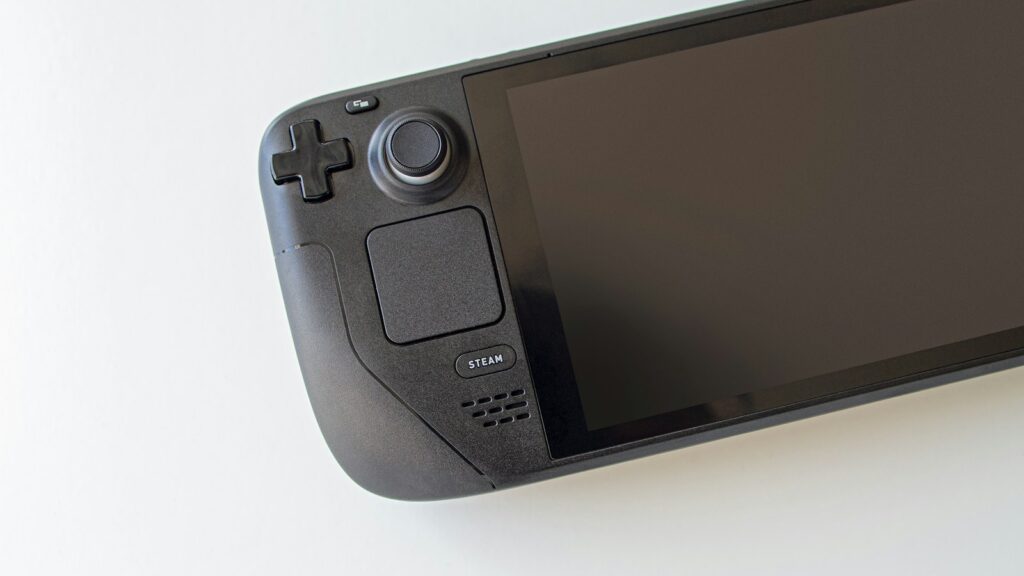
SteamOS 3.8.28 is now on Valve’s Stable channel, but the long changelog does not affect every handheld in the same way.
The biggest platform-wide changes are a major Mesa graphics-driver update and revised VRAM management. The most actionable changes, however, are often device-specific: MSI Claw gets several fixes, Lenovo Legion Go gets gyro and battery corrections, OneXPlayer models gain controller changes, and AYANEO Pocket S2 and Konkr FIT receive initial gamepad support.
There is also an important version distinction. SteamOS 3.9 is already in Beta. This guide is about 3.8.28 Stable, the version ordinary Stable-channel users are receiving, not the newer experimental 3.9 branch.
Quick answer: what matters most in SteamOS 3.8.28?
For most users, the update falls into three groups:
- Graphics and memory changes: Valve updated Mesa to a new major release and says it contains many ray-tracing performance improvements. Valve also says VRAM management is greatly improved when graphics memory is limited.
- General stability fixes: Valve fixed several launch, suspend/resume, display, Wi-Fi and controller problems.
- Third-party handheld support: MSI Claw, Legion Go, OneXPlayer, AYANEO and other devices receive model-specific controller, battery, gyro or resume changes.
What Valve does not publish is a universal FPS improvement. There is no percentage uplift for Steam Deck, no game-by-game benchmark table and no claim that every device benefits equally.
SteamOS 3.8.28 Stable is not the same as SteamOS 3.9 Beta
Valve released SteamOS 3.8.28 to all users on September 24.
A day later, SteamOS 3.9.2 was available in the Beta/Preview path. That newer branch includes changes that are not part of 3.8.28, including preliminary Legion Go 2 brightness support.
That distinction matters when reading troubleshooting posts or feature lists. A fix reported for SteamOS 3.9 Beta should not automatically be treated as available on 3.8.28 Stable.
For this article, every device-specific change below comes from Valve’s 3.8.28 Stable notes unless stated otherwise.
The Mesa and VRAM changes are important, but Valve does not quantify them
Valve says SteamOS 3.8.28 updates the Mesa graphics driver to a new major release with many ray-tracing performance improvements, alongside other performance and functionality changes.
Valve separately says VRAM management is greatly improved, improving performance and stability when VRAM is limited.
Those are meaningful platform changes, but they are not benchmark results.
Steam Deck itself uses an AMD APU with 16 GB of on-board LPDDR5 memory. Valve does not publish a general “Steam Deck is X percent faster” claim for 3.8.28, so the safe interpretation is that graphics-memory handling and driver behavior have improved without assuming a specific gain in every game.
The same caution applies to ray tracing. A newer Mesa path can improve ray-tracing behavior, but the size of the change still depends on the game, hardware, settings and workload.
Which handhelds get specific fixes?
| Device | What Valve changed in SteamOS 3.8.28 |
|---|---|
| Steam Deck | General Mesa/VRAM/system changes plus a rare fan-control regression fix |
| MSI Claw variants | Broader variant support |
| MSI Claw 8 EX AI+ | Initial gamepad support |
| Some MSI Claw systems | Guide/Quick Access button regression fix on newer firmware |
| MSI Claw | Resume-freeze fix when an SD card is present |
| Lenovo Legion Go 1 | Gyro initialization fix on older controller firmware |
| Lenovo Legion Go models | Battery-display fixes |
| OneXPlayer Apex | Updated gamepad support with new firmware |
| OneXPlayer F1 | Added controller support and fixed rumble/joystick polling regression |
| OneXPlayer 2 special editions | Added controller support for previously missing models |
| AYANEO Pocket S2 | Initial gamepad support |
| Konkr FIT | Initial gamepad support |
One wording detail matters here: initial gamepad support is not the same claim as complete official device support.
Valve’s notes describe specific input/controller changes. Unless Valve documents broader support elsewhere, this article should not upgrade that wording into a blanket promise that every feature on a device is fully supported.
MSI Claw gets several of the most practical fixes
SteamOS 3.8.28 improves support for MSI Claw device variants.
Valve also lists three more specific changes:
- initial gamepad support for MSI Claw 8 EX AI+
- a fix for some MSI Claw devices on newer firmware losing the Guide and Quick Access Menu buttons
- a fix for a freeze on resume when an SD card was present during suspend/resume.
These are better reasons to care about 3.8.28 than a generic “performance update” label if one of those problems matches your device.
Lenovo Legion Go fixes focus on gyro and battery reporting
For Legion Go 1, Valve fixed a regression where the gyroscope could fail to initialize on older controller firmware.
Valve also says it fixed battery-display problems on Lenovo Legion Go models.
Do not mix those Stable fixes with SteamOS 3.9 Beta changes. Preliminary Legion Go 2 brightness control appears in the 3.9.2 Beta notes, not in the 3.8.28 Stable changelog.
OneXPlayer support expands, with one explicit F1 trade-off
Valve says SteamOS 3.8.28 improves support for OneXPlayer variants and updates gamepad support for OneXPlayer Apex systems using new firmware.
It also adds controller support for missing OneXPlayer F1 and OneXPlayer 2 special-edition models.
The F1 has an important caveat. Valve fixed a regression that blocked rumble and reduced joystick polling, but explicitly says the left M1 extra shoulder button can no longer function as a consequence.
That trade-off is worth checking before updating if M1 is part of your current control setup.
AYANEO Pocket S2 and Konkr FIT get initial gamepad support
Valve lists initial gamepad support for both AYANEO Pocket S2 and Konkr FIT.
Again, the word initial matters.
This is evidence that Valve added gamepad support for these devices. It is not enough on its own to claim complete support for every device function, power-management feature or accessory.
There are useful fixes beyond the named handhelds
SteamOS 3.8.28 also fixes several problems that can matter across supported hardware.
Valve says it fixed:
- a 20–30 second startup delay in some games on non-Valve devices with no audio sources
- delayed Proton game startup when no capture device is present
- black screens in some launchers, including Zenless Zone Zero and Final Fantasy XIV Online
- some slow or stuck Wi-Fi connections
- a system freeze on resume if an SD card was removed while suspended
- game-performance degradation after sleep/resume on systems with AMD discrete GPUs.
These are condition-specific fixes. If you did not have the underlying problem, the changelog is not promising a new performance gain.
Should you install SteamOS 3.8.28?
If you use the Stable channel, 3.8.28 is the current Stable release covered by Valve’s September 24 notes.
The update is especially relevant if:
- your MSI Claw, Legion Go or OneXPlayer matches one of the listed fixes
- you experienced a suspend/resume problem described by Valve
- your system had one of the launcher, Wi-Fi, display or controller regressions in the changelog
- you want the Stable Mesa/VRAM changes without moving to the 3.9 Beta branch.
What you should not expect is a guaranteed FPS increase in every game.
If your reason for updating is one specific performance problem, verify that Valve actually lists that condition rather than assuming the words “performance improvements” cover it.
What we are not claiming
Instant Game Zone did not benchmark SteamOS 3.8.28 for this article.
We are not claiming:
- a specific FPS improvement
- a specific ray-tracing uplift
- a specific VRAM saving
- full support for every third-party handheld mentioned in the changelog.
This guide maps Valve’s Stable release notes to the hardware they explicitly mention.