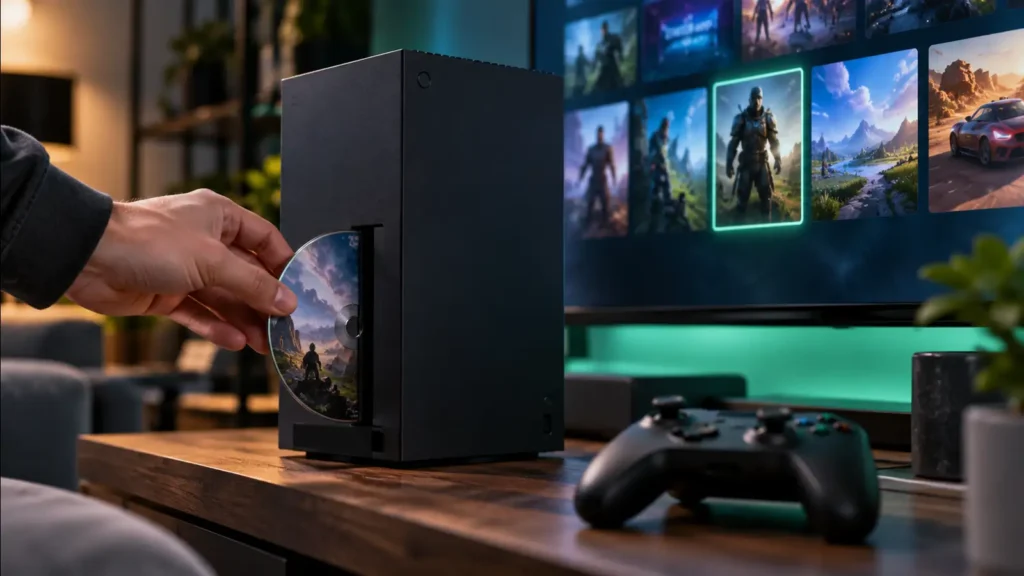
Xbox’s disc-to-digital licensing feature is now rolling out beyond Insider testing, letting owners of supported Xbox One and Xbox Series X game discs claim a limited digital licence while keeping the physical disc as the proof of ownership.
The useful part is not simply that a disc can become “digital.” The important detail is that Microsoft does not treat the result like a normal permanent digital purchase. The digital access remains tied to continued possession of the qualifying disc.
That distinction matters if you plan to use a disc-based collection on a disc-less Xbox, on PC through Xbox Play Anywhere, or through Xbox Cloud Gaming where the individual game supports those options.
Quick answer: how Xbox Disc-to-Digital works
Microsoft’s official Xbox Wire announcement says the process starts by inserting a supported Xbox One or Xbox Series X disc into a supported Xbox console while signed in. The console can then grant a digital entitlement for that game.
Once the entitlement exists, Microsoft says supported games can gain the normal advantages of digital access, including Xbox Play Anywhere and Xbox Cloud Gaming where those features are already supported by the game.
The physical disc itself still works normally.
Microsoft’s usage rules add the most important limitation: this is a limited-access digital licence. It remains conditioned on continued possession of the qualifying disc, and Microsoft may require the user to revalidate eligibility.
This is not a permanent conversion of a disc into a digital purchase
The safest way to think about the feature is:
- you keep the physical game
- the supported disc can grant digital access
- the digital licence depends on that disc remaining yours
- the disc can continue to work as a normal physical copy
If you sell, give away or otherwise stop possessing the qualifying disc, Microsoft’s usage rules say access to the associated digital licence may be suspended or revoked.
So this is not a loophole that lets one physical copy become two independent licences. The disc remains the ownership anchor.
Which Xbox discs are supported?
Xbox’s original announcement says most Xbox One and Xbox Series X disc-based games support the system, with thousands of titles included as the program starts.
Microsoft also says not every title is eligible. Eligibility can vary because of technical, licensing, publishing or other factors, and Microsoft may add or remove support for specific discs over time.
Current Xbox Support guidance is limited to Xbox One and Xbox Series X game discs. Xbox 360 and original Xbox discs are not part of the current disc-to-digital program.
That means backward compatibility by itself does not guarantee disc-to-digital eligibility. A game can work through Xbox backward compatibility and still fall outside this licensing system.
Can you use it with Xbox Series S?
An Xbox Series S cannot perform the initial disc claim because it has no optical drive.
However, Microsoft defines disc-to-digital games as using the normal Xbox One and Xbox Series digital-game access model, subject to the extra disc-possession rules. That means a claimed game can be useful on compatible disc-less hardware after the entitlement has been created on a supported disc-capable Xbox.
The important practical limitation is that you still need access to a supported console with a disc drive to make the initial claim, and Microsoft may require later eligibility revalidation.
What about Xbox Play Anywhere and cloud gaming?
The feature does not automatically add Xbox Play Anywhere or cloud support to a game that never had those capabilities.
Xbox’s announcement says those benefits apply where supported.
If a disc-to-digital title already participates in Xbox Play Anywhere, its digital entitlement can extend to compatible Windows devices under the normal Play Anywhere rules. Cloud access likewise depends on the game and the Xbox service supporting it.
So the correct question is not just “Does this disc support disc-to-digital?” It is also “Which digital features does this particular game already support?”
Why this matters for physical game owners
The biggest benefit is flexibility.
A physical collection can become easier to use across the modern Xbox ecosystem without forcing the owner to buy the same game again as a separate digital purchase.
That is especially relevant to players who:
- own a large Xbox One or Xbox Series physical library
- use more than one Xbox in the same household
- want to use a compatible disc-based game on disc-less hardware after claiming it
- own Play Anywhere titles that can also run on PC
- want digital convenience while retaining a physical copy
The limitation is equally important: the feature is designed to preserve the connection between the digital access and the physical disc. Keeping the disc is therefore part of the licence model, not an optional extra.
What has changed now?
Microsoft introduced the feature on August 26, 2026 and began Insider testing on August 31.
On September 29 and 30, the public rollout began reaching all players. The underlying rules remain the ones Microsoft documented during the Insider introduction and in its current usage rules: supported Xbox One and Xbox Series X discs can grant limited digital licences, while eligibility remains title-dependent.
If a disc does not produce the expected entitlement, do not assume every physical game is supported. Check Xbox’s current support guidance first.
What Xbox Disc-to-Digital does not promise
It does not promise:
- support for every Xbox disc
- support for Xbox 360 or original Xbox discs under the current program
- a permanent digital licence after you dispose of the physical disc
- Xbox Play Anywhere for games that do not already support it
- cloud gaming for every converted title
- removal of hardware or peripheral requirements for games that need them
Those limits are important because “disc-to-digital” sounds broader than the actual licensing model.