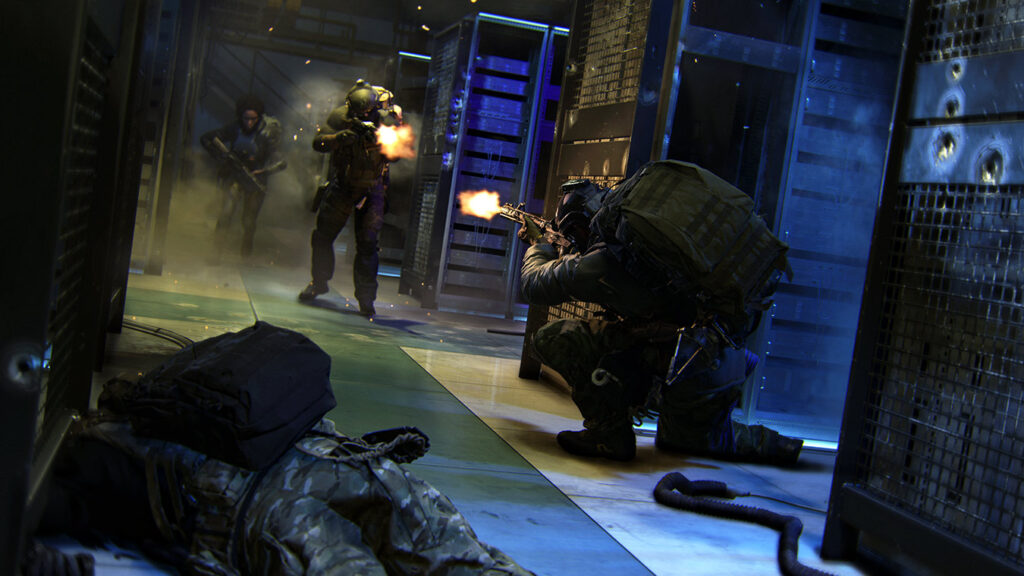
Modern Warfare 4 launched worldwide on October 23, 2026. Server Culling is designed to limit one source of wallhack information by withholding hidden-opponent position data from a player’s device when the server determines that player should not be visible.
That design may reduce the useful data available to cheats that rely on hidden positions. It does not show that wallhacks or cheating have been eliminated. As of October 30, Activision’s public launch updates do not provide measured Server Culling effectiveness or independent live-match results.
The careful conclusion is narrow: Server Culling is a new anti-cheat data-control layer inside RICOCHET. Its real-world effect still needs evidence.
What is Server Culling in Modern Warfare 4?
Server Culling changes what opponent-location information the game server sends to a player’s device.
In Call of Duty’s own explanation, cheat software cannot reveal information it never receives. If a player should not know where an opponent is, the server can withhold that opponent’s location data from the player’s hardware.
That is different from only trying to detect a wallhack after cheat software has already read hidden-player coordinates. The server is instead trying to remove some of the useful hidden-position data at the source.
Why wallhacks can use hidden player data
A legitimate player only sees what the game renders on screen, but the game client may still receive information about opponents who are behind walls, terrain or other cover. Unauthorized software can try to read game data that the player was never meant to see and turn it into an overlay or other unfair advantage.
Activision’s current security policy explicitly lists wallhacks among unauthorized cheating software and says RICOCHET uses multiple detection methods, including client-side and server-side systems, behavioral models and hardware-integrity checks.
Server Culling adds a different kind of defense to that stack. Instead of relying only on detection, it reduces the hidden-opponent information available to the client in the first place.
How MW4’s map visibility layers fit in
Call of Duty describes Server Culling as a map-aware visibility system. The practical idea is that the server needs to know when an opponent’s position should be available to another player’s client and when it can stay hidden.
That makes the system closely tied to map geometry and visibility rather than a single global switch. The October 2 announcement says the protection is being built across every Modern Warfare 4 map available at launch.
For players, the important part is not the name of the visibility layer. It is the data boundary: when the server decides an opponent should be hidden, that opponent’s location can be withheld from the receiving hardware rather than merely hidden by the normal game renderer.
Where Server Culling will be used
- Every Modern Warfare 4 launch map
- DMZ
- Combat Outpost
- New Multiplayer maps from Season 1 onward
- New DMZ maps from Season 1 onward
- New Call of Duty: Warzone maps from Season 1 onward
That wording is important. Activision’s announcement specifically promises the system for MW4’s launch maps and the named live-season content. It should not be expanded into a claim that every existing Warzone environment or every historical Call of Duty map automatically receives the same treatment.
Does Server Culling eliminate wallhacks?
No published evidence supports that claim. Server Culling is designed to make wallhacks less useful when they depend on hidden-opponent position data the server can withhold. The game is now live, but the official sources reviewed for this update do not publish measured live-match effectiveness or independent results showing how often the system prevents a wallhack from exposing an opponent.
Wallhacks are also only one category of cheating. Activision’s security policy identifies other unauthorized software and behavior, and RICOCHET is a layered system. The evidence-supported claim remains specific: Server Culling is intended to limit hidden-position data available to a client. That is not proof that cheating broadly has disappeared.
What public evidence still does not show
Activision’s launch patch notes document changes and fixes after release, but the sources reviewed here do not publish:
- measured wallhack effectiveness before and after Server Culling
- independent live-match results that isolate the system’s effect
- latency or network-overhead measurements attributable to Server Culling
- a full account of visibility edge cases or how each is handled
- long-term results as maps and cheat techniques change
These are evidence gaps, not proof that the system is ineffective. They mark what cannot yet be concluded from the public information reviewed.
How Server Culling fits into RICOCHET Anti-Cheat
RICOCHET is broader than Server Culling. Call of Duty describes it as a multi-layered anti-cheat initiative combining server-side tools with client-side protections, including a kernel-level driver on PC.
Activision’s enforcement policy says its detection systems can look for unauthorized programs, behavioral anomalies, manipulated hardware and attempts to reveal information that should not be known.
Server Culling fits into that last problem from the opposite direction: rather than only detecting an attempt to reveal hidden information, it can avoid sending some of that information to the client at all.
That also explains why Server Culling should not be judged as a replacement for the rest of RICOCHET. It solves a specific data-exposure problem inside a much larger anti-cheat system.
What do players know now that Modern Warfare 4 is live?
Modern Warfare 4 launched on PlayStation 5, Xbox Series X|S, PC and Nintendo Switch 2 on October 23, 2026. Activision’s October 28 patch notes report post-launch fixes across Multiplayer and DMZ, but do not quantify Server Culling’s effect on cheating.
If the system works as designed, a wallhack that depends on receiving the position of a fully hidden opponent should have less useful data to expose. Whether that happens reliably across live maps, changing sightlines and new cheat techniques requires measurements or independently reproducible testing. We have not independently tested Server Culling for this article.
For PC hardware and launch requirements, see our Modern Warfare 4 PC requirements guide.
Sources: Activision’s worldwide launch announcement and October 28 launch patch notes.
What to watch next
The useful follow-up evidence would be concrete: measured or reproducible tests of hidden-opponent visibility, a public explanation of effectiveness and edge cases, and updates that show how protection is applied as maps and modes change. Player reports can identify problems, but they do not by themselves measure the system’s overall success.
Until stronger evidence is published, describe Server Culling as an intended mitigation for one information source used by wallhacks. Do not treat it as proof that cheating is solved.
Sources
- Call of Duty: Server Culling announcement, October 2, 2026
- Call of Duty: RICOCHET Anti-Cheat overview
- Activision: Call of Duty Security and Enforcement Policy
- Call of Duty: Modern Warfare 4 Launch Patch Notes, updated October 28, 2026
- Call of Duty: Modern Warfare 4 is Live Worldwide, October 23, 2026
- Call of Duty: Modern Warfare 4 official site
Instant Game Zone has not independently measured Server Culling’s live-match effectiveness for this article. The claims above are limited to the design description and public evidence identified in the linked sources.