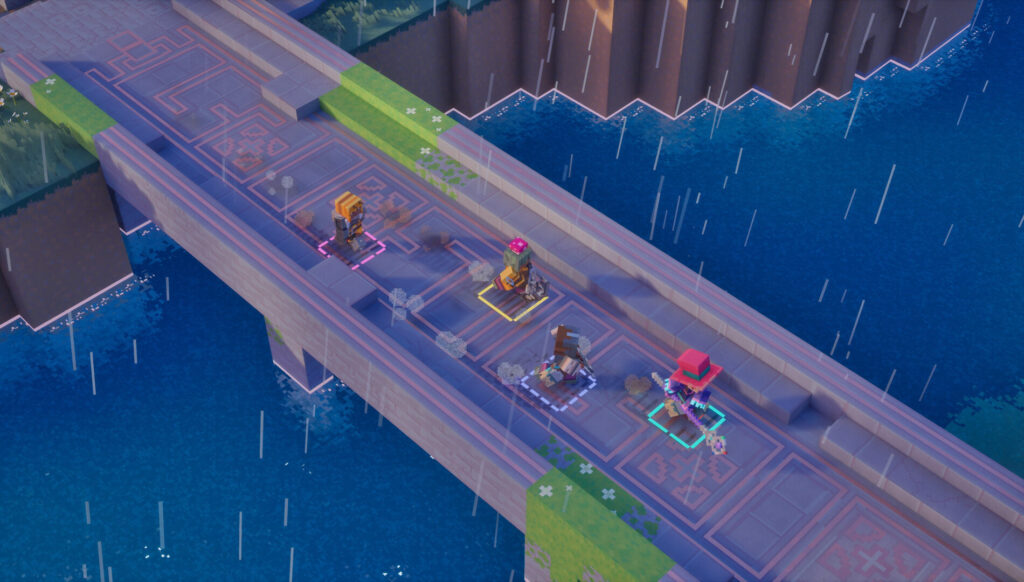
Crossplay is the easy part in Minecraft Dungeons II.
Mojang supports up to four players in couch, online, and mixed co-op, and players can join friends across platforms. The confusing part is everything around that: whether one purchase works on another store, whether your hero follows you, whether each console player needs an online subscription, and whether every member of the party needs the same DLC.
Those are separate rules.
This guide separates crossplay, cross-progression, cross-buy, online access, and DLC ownership so you can work out what your specific group needs before everyone starts buying the wrong edition or subscription.
The short answer
| Question | Short answer |
|---|---|
| Can different platforms play together? | Yes. Mojang supports cross-platform parties, including Party Codes that work regardless of platform. |
| Can couch players join remote friends? | Yes. Mojang says an online couch session can accept remote players, creating a mixed local and online party. |
| Does your hero follow you to another platform? | It can. Mojang says linking your platform accounts to the same Microsoft account lets you continue with the same hero across platforms. |
| Does buying the game on one platform give you every version? | No. Xbox Play Anywhere covers a digital Microsoft Store purchase across Xbox and Windows PC. That does not grant Steam, PlayStation, or Nintendo licenses. |
| Do console players need an online subscription? | Yes for online console play. Xbox, PlayStation, and Nintendo each have their own online-access requirements. |
| Does everyone need the DLC? | No. Mojang says a non-DLC player can join a friend’s DLC session through an invitation or Party Code, but cannot use matchmaking to enter DLC sessions. |
The most important thing is not to treat all of these as the same feature. Crossplay answers whether two platforms can connect. It does not prove that one purchase works everywhere, that every subscription is included, or that every party member owns the same DLC.
Can Xbox, PlayStation, Nintendo and PC players play together?
Mojang describes Minecraft Dungeons II as a cross-platform co-op game. Its official multiplayer deep dive says friends can connect even when they are playing on another platform, and Party Codes are designed to work regardless of platform.
The game is available on Steam, Xbox Series X|S, PlayStation 5, Nintendo Switch, and Nintendo Switch 2.
Mojang also supports more than one type of four-player group.
| Group setup | Supported? | What matters |
|---|---|---|
| Four players on one supported system | Yes | Couch co-op is supported. Local player limits depend on the platform listing. |
| Remote friends on different platforms | Yes | Use the normal online party flow, Party Codes, or supported friend/account systems. |
| Couch players plus remote friends | Yes | Mojang explicitly describes mixed co-op where an online couch session can accept remote players. |
| Join a specific friend | Yes | An eight-character Party Code can be used to join that party. |
| Find other players automatically | Yes | Matchmaking can find a party or fill empty spaces, subject to the game’s matching rules. |
Mojang says matchmaking can consider factors such as quest progress, region, and power level. It can also place a player into a session that is already in progress.
The sequel uses dedicated servers for online sessions rather than making the party leader host the session. That is useful context for how multiplayer is structured, but it is not evidence that every region or platform will have the same latency or matchmaking experience. Instant Game Zone did not test multiplayer latency or server performance.
Sources: Mojang’s Dungeons II co-op deep dive and Minecraft Dungeons II launch article.
Does your Minecraft Dungeons II hero follow you across platforms?
Mojang says hero data is stored online instead of being tied only to one device.
For moving between platforms, the important rule is account linking: if the relevant platform accounts are linked to the same Microsoft account, Mojang says you can continue with the same hero.
That is cross-progression.
It is not the same as cross-buy.
If you own the game on Steam and later want to play on PlayStation 5, cross-progression does not automatically give you the PlayStation license. The account connection can carry your hero, while the game license still follows the store or access method you use.
Mojang also says a player may be able to bring their own hero when playing on a friend’s device if that platform supports signing into the player’s own platform account.
That qualifier matters. Mojang does not publish a complete platform-by-platform table proving that every possible local sign-in setup behaves the same way.
A current couch co-op caution
Current Minecraft Feedback posts describe problems with local or offline secondary-player hero persistence on different platforms. These are player reports on Mojang’s feedback platform, not an official confirmation that every platform shares one universal couch-save defect.
The safe conclusion is:
- Mojang’s official design supports online hero storage and cross-platform continuation through linked accounts
- local secondary-player persistence may depend on the platform and sign-in flow
- current player reports on Minecraft Feedback describe local secondary-player persistence problems, but Mojang has not broadly confirmed a universal couch-save defect
If your family plans to build long-running heroes through couch co-op, do not assume a guest profile will behave exactly like a separately signed-in account until the current platform behavior is confirmed.
Instant Game Zone has not reproduced these reports first-hand.
Does one purchase work on Xbox, Windows, Steam, PlayStation and Switch?
No.
The clearest cross-buy exception is Xbox Play Anywhere.
Mojang’s ownership support page says that if you buy Minecraft Dungeons II digitally through the Microsoft Store on Xbox or Windows, you can use that purchase on both Xbox consoles and Windows PCs when signed into the same purchasing Microsoft account.
That does not mean every storefront shares the same license.
| Purchase path | Does the same purchase carry over? | Current rule |
|---|---|---|
| Microsoft Store on Xbox to Windows PC | Yes | Supported through Xbox Play Anywhere with the same purchasing Microsoft account. |
| Microsoft Store on Windows to Xbox | Yes | Supported through Xbox Play Anywhere with the same purchasing Microsoft account. |
| Xbox or Microsoft Store to Steam | No evidence of shared ownership | Treat Steam as a separate store license. |
| Xbox or Microsoft Store to PlayStation 5 | No evidence of shared ownership | Treat PlayStation as a separate store license. |
| Xbox or Microsoft Store to Nintendo Switch / Switch 2 | No evidence of shared ownership | Treat Nintendo as a separate store license. |
So if your hero can continue on another platform, that still does not mean your purchase follows it.
Source: Minecraft Dungeons II Editions, Ownership, and Purchase Support.
What online subscription does each console need?
For online console multiplayer, the platform’s own subscription rules still apply.
| Platform | Online-play requirement | Important note |
|---|---|---|
| Xbox Series X|S | Use a current Xbox Game Pass plan that includes online console multiplayer | Xbox’s current Game Pass plan pages list online console multiplayer with Essential, Premium, and Ultimate. |
| PlayStation 5 | PlayStation Plus | Sony lists PS Plus as required for online play and supports up to four online players. |
| Nintendo Switch / Switch 2 | Nintendo Switch Online and a Nintendo Account | Nintendo lists the membership as required for online features. |
| Steam / Windows PC | No separate console-style online subscription | You still need the required game/store and Microsoft account setup. |
Why the Xbox row needs extra care
The current Xbox Game Pass plan pages use Essential, Premium, and Ultimate and show online console multiplayer in the current console plans.
However, the Minecraft Dungeons II Xbox Store page still contains older wording that says online console multiplayer requires Game Pass Core or Ultimate.
Those two official Xbox surfaces are not fully synchronized.
For choosing a subscription today, use the current Xbox Game Pass plan comparison rather than treating the older store-page tier names as the current plan list.
This is separate from whether Game Pass gives you access to the base game.
Is Minecraft Dungeons II included with Game Pass?
Game availability and online multiplayer access are separate benefits.
Xbox’s current information supports the following distinction:
- Game Pass Ultimate: Minecraft Dungeons II is listed as a day-one Game Pass title, and Ultimate includes online console multiplayer
- PC Game Pass: Minecraft Dungeons II is listed as a day-one PC Game Pass title
- Game Pass Premium and Essential: their console plans include online console multiplayer, but that does not by itself mean Minecraft Dungeons II is included in the game library
The Minecraft Dungeons II Xbox Store currently marks the game as included with Ultimate.
If you are relying on Game Pass instead of buying the game, verify both the current game catalog and your target device before assuming your subscription includes it.
In other words, a plan can satisfy the online-play requirement for an owned copy without necessarily providing the game license itself.
Sources: Xbox Game Pass plan comparison, Xbox Game Pass overview, and Minecraft Dungeons II on Xbox.
Do all players need the Deluxe Edition or DLC?
No.
This is one of the most useful exceptions in Mojang’s support documentation.
A player who owns the DLC can host a DLC session. A friend who does not own that DLC can still join through a Party Code or invitation.
The non-DLC player cannot use matchmaking to enter DLC sessions.
| Situation | Can the player enter? | Rule |
|---|---|---|
| DLC owner hosts and invites a non-DLC friend | Yes | The non-DLC player can join through Party Code or invitation. |
| Non-DLC player searches matchmaking for DLC content | No | Mojang says non-DLC owners cannot join DLC sessions through matchmaking. |
| DLC owner joins a normal non-DLC session | Yes | DLC content is not available inside that non-DLC session. |
| Non-DLC player earns progress in a friend’s DLC session | Partly persistent | Mojang says some DLC progress may be saved for later DLC sessions or after purchase. |
That means “everyone must buy the DLC” is too broad.
It also means “one person owns the DLC, so everyone has full DLC access everywhere” is too broad.
The way the party is formed matters.
Source: Minecraft Dungeons II Editions, Ownership, and Purchase Support.
Standard vs Deluxe vs Deluxe Upgrade
Mojang currently separates the purchase options like this:
- Standard Edition: the base game
- Deluxe Edition: the base game, extra cosmetics, and DLC 1 and DLC 2 as they are released
- Deluxe Upgrade: for Standard owners who want the Deluxe cosmetics plus DLC 1 and DLC 2
Mojang’s US support page currently lists the Deluxe Upgrade at $20. US storefronts currently show the Standard game around $29.99 and Deluxe around $49.99.
Those prices are regional and can change, so they should be rechecked before WordPress publication.
Do not describe Deluxe as including every future DLC. The current official wording is specifically DLC 1 and DLC 2.
Three example groups
Example 1: Xbox player and Steam player
They can play together through crossplay.
The Steam player needs their Steam game access and required Microsoft-account setup. The Xbox player needs game access on Xbox plus a current Xbox subscription that supports online console multiplayer.
If both platform accounts are connected correctly to the relevant Microsoft account, Mojang’s cross-progression system can let a player continue the same hero across supported platforms.
The Xbox purchase does not grant the Steam license.
Example 2: Two couch players plus one remote PS5 friend
Minecraft Dungeons II supports mixed couch and online co-op.
The PS5 player needs PlayStation Plus for online play. The couch side needs the game and the local player/account setup supported by that platform.
If the second couch player cares about long-term hero persistence, treat local secondary-player behavior as platform- and sign-in-dependent. Minecraft Feedback users are still reporting save and hero-persistence problems, but those reports are not a universal bug confirmation.
Example 3: Deluxe owner invites a Standard owner into DLC
The Standard owner does not automatically need to buy the DLC just to join that friend’s DLC session.
Mojang says the non-DLC player can join through an invitation or Party Code.
The same non-DLC player cannot use matchmaking to search for DLC sessions.
What to recheck before you buy or set up a long-running group
If you are reading this after the first launch week, recheck these items before spending money or committing a family save:
- the current Minecraft Dungeons II ownership support page
- the current Xbox Game Pass plan names and game inclusion
- PlayStation Plus and Nintendo Switch Online requirements
- Mojang’s current known issues for account linking and local co-op
- whether DLC 1 or DLC 2 has launched and whether its access rules changed
- current regional pricing for Standard, Deluxe, and the Deluxe Upgrade
The core crossplay design is broad. The entitlement details are the part most likely to change.
Related Instant Game Zone coverage
For more current game guides and decision support, see the Games hub.
If you are working on Minecraft Java rather than Dungeons II, the Minecraft Java 26.2 Vulkan known-issues tracker covers a separate PC renderer and compatibility topic.
Sources
Primary and platform sources reviewed for this draft:
- Minecraft Dungeons II is live
- Mojang Dungeons II co-op deep dive
- Minecraft Dungeons II Editions, Ownership, and Purchase Support
- Minecraft Dungeons II on Xbox
- Minecraft Dungeons II Xbox Store listing
- Xbox Game Pass plan comparison
- Xbox Game Pass overview
- Minecraft Dungeons II on PlayStation
- Minecraft Dungeons II on Nintendo Switch 2
- Minecraft Dungeons II on Steam
- Minecraft Feedback: PS5 offline couch co-op lost Player 2 progress (player report)
Community reports were reviewed only as directional evidence for local/couch hero-persistence concerns and are not treated as proof of a universal bug.