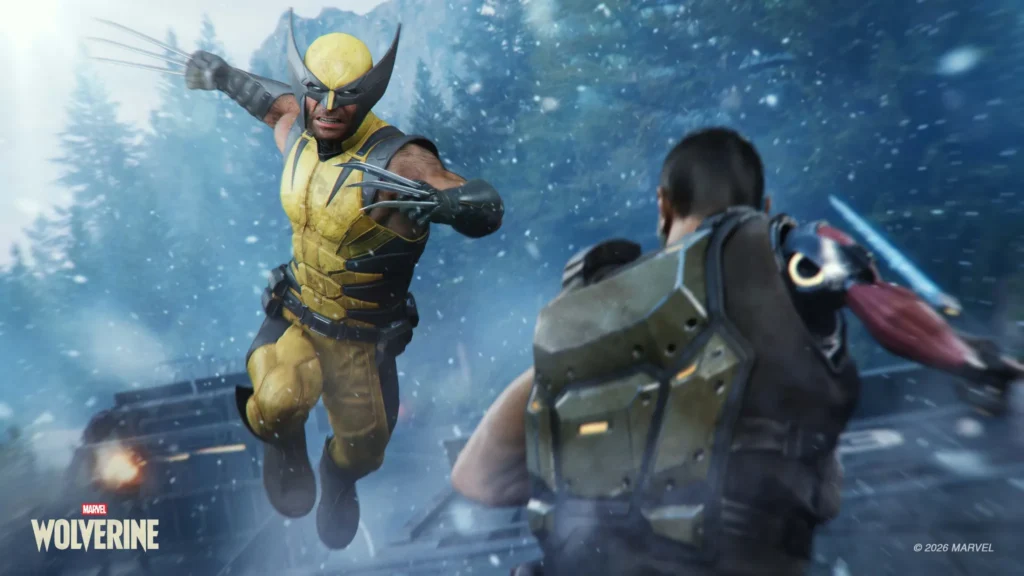
Quick Spectral Super Resolution, or QSSR, is now available on the standard PS5. Sony launched the new AI-guided upscaling library on October 1, 2026, with Marvel’s Wolverine and Ghost of Yōtei as the first supported games.
You do not need a PS5 Pro to use QSSR. Sony built QSSR specifically to bring some of the image-detail and image-stability benefits of AI upscaling to the standard PS5. PS5 Pro continues to use PlayStation Spectral Super Resolution, or PSSR, which Sony still describes as its higher-end path.
The important detail is that QSSR behavior can differ by game. Insomniac says Wolverine Update 1.002.000 uses QSSR on PS5 by default. Sony confirms Ghost of Yōtei also supports QSSR, but describes it as an additional graphics option and does not state its default behavior in the QSSR announcement.
This page tracks those differences instead of treating every QSSR game as if it works the same way.
Current PS5 QSSR supported games
| Game | QSSR support | Patch or update | Default or option behavior | Last verified |
|---|---|---|---|---|
| Marvel’s Wolverine | Confirmed | Update 1.002.000 | QSSR is on by default on PS5. Insomniac’s current patch note does not establish the exact menu or toggle behavior. | October 2, 2026 |
| Ghost of Yōtei | Confirmed | QSSR-specific patch identifier not established in the reviewed QSSR source | Sony says QSSR is added as an additional graphics option. Default state is not stated in the reviewed source. | October 2, 2026 |
Primary evidence:
- Sony Interactive Entertainment: AI upscaling is coming to PS5
- Insomniac Games: Marvel’s Wolverine Update 1.002.000
Sony says QSSR will be offered broadly to PlayStation developers, so this list can expand. That does not mean every future PS5 game will support it. A game belongs in this table only after Sony or its developer confirms QSSR support.
QSSR brings AI-guided upscaling to the standard PS5
QSSR stands for Quick Spectral Super Resolution. Sony describes it as a new performance tier of AI upscaling created through Project Amethyst, its graphics collaboration with AMD.
According to Sony, QSSR is built around two changes: a streamlined neural-network architecture and a hand-tuned implementation designed to maximize performance on PS5. Sony says the result improves image detail and image stability compared with conventional approaches on the standard console.
Those are Sony’s claims about the technology, not independent performance measurements in this article. Treat them as first-party feature claims rather than measured proof of image quality, internal resolution, frame rate, latency, or reconstruction cost.
The distinction matters because the standard PS5 did not previously have PSSR. Sony says PSSR’s computational demands made that implementation impractical on the base console. QSSR is the performance-oriented path intended to bring related AI-upscaling benefits to that hardware.
QSSR and PSSR are related, but they target different PlayStation consoles
| Field | QSSR | PSSR |
|---|---|---|
| Main target | Standard PS5 | PS5 Pro |
| Technology | AI-guided upscaling | AI-guided upscaling |
| 2026 lineage | Project Amethyst with AMD | Upgraded 2026 PSSR also stems from Project Amethyst |
| Sony’s positioning | Performance-oriented path for PS5 | Higher-end, “gold standard” path on PS5 Pro |
| First confirmed QSSR rollout | Marvel’s Wolverine and Ghost of Yōtei | PSSR was already established across PS5 Pro titles |
Sony said in February 2026 that PSSR had already been used to boost effective resolution in more than 50 PS5 Pro titles. The company later upgraded PSSR with newer Project Amethyst technology. QSSR takes that broader work in a different direction by targeting the standard PS5.
That does not establish that QSSR and PSSR produce the same image quality, use the same internal resolution, or cost the same amount of GPU time. Sony continues to position PSSR above QSSR on PS5 Pro.
Source: Sony Interactive Entertainment: Upgraded PSSR upscaler is coming to PS5 Pro
Marvel’s Wolverine uses QSSR by default on PS5
Insomniac’s Update 1.002.000 is the clearest per-game implementation note available at launch.
The studio says the update makes Marvel’s Wolverine use QSSR on PS5 and lists QSSR as on by default. Insomniac attributes improvements in image detail and image stability to the change.
That is more specific than Sony’s platform-level wording that both launch games are being patched to offer QSSR as an additional graphics option. For Wolverine, the developer’s own patch note is the stronger source for actual game behavior.
What the current patch note does not tell us is whether Wolverine exposes a separate QSSR toggle, whether every graphics mode uses it in exactly the same way, or what internal rendering resolution is used. Those details remain unconfirmed in the sources reviewed for this tracker.
Ghost of Yōtei supports QSSR, but its default state is not confirmed
Sony names Ghost of Yōtei alongside Wolverine as one of the first two QSSR games. The October 1 QSSR announcement says both titles are being patched to offer QSSR as an additional graphics option on PS5.
That confirms support. It does not answer every implementation question.
The reviewed QSSR source does not say whether Ghost of Yōtei enables QSSR automatically, what the exact menu label is, or whether every graphics mode can use it. It also does not explicitly bind QSSR to a specific Ghost of Yōtei patch-version number.
Ghost of Yōtei’s broader October update has other documented version information, but this tracker does not merge separate source claims unless the QSSR change itself is tied to that version by a first-party source.
If you are trying to decide what is free in the October Ghost update and what belongs to the paid Complete Edition Upgrade, see our separate Ghost of Yōtei Complete Edition breakdown. That article covers the ownership and content question. This page tracks QSSR graphics support.
You do not need a PS5 Pro for QSSR
QSSR was announced for the standard PS5.
Sony introduced it because players and developers wanted image-quality improvements similar to PSSR on hardware where the full PSSR path had been too computationally demanding. QSSR uses a streamlined network and a PS5-focused implementation to make AI-guided upscaling practical on the standard console.
PS5 Pro still has a separate advantage here. Sony continues to call PSSR the gold standard on PS5 Pro, so QSSR should not be described as making the two consoles equivalent.
The practical split is simple:
- standard PS5: QSSR where a game adds support
- PS5 Pro: PSSR where a game supports Sony’s Pro upscaler
A game’s support still depends on its developer. QSSR is not a system-wide switch that automatically changes every PS5 title.
How do you turn on QSSR?
There is no safe universal instruction yet because the first two games do not have identical first-party documentation.
For Marvel’s Wolverine, Insomniac says QSSR is on by default after Update 1.002.000. You should not need to enable it merely to get the default QSSR behavior described in that patch note.
For Ghost of Yōtei, Sony says the patch adds QSSR as an additional graphics option. The QSSR announcement does not provide an exact menu path or state whether that option is selected automatically.
That difference is why this tracker records behavior per game. As more titles adopt QSSR, a generic “turn on QSSR” instruction could become misleading.
More QSSR games are likely, but only confirmed titles belong in the list
Sony says QSSR will be offered broadly to PlayStation developers and that it expects the technology to appear in more games.
That is a platform availability statement, not a supported-games list.
A game will be added here only when one of these exists:
- a PlayStation announcement naming QSSR support
- developer or publisher patch notes naming QSSR
- first-party support documentation that explicitly identifies QSSR behavior
A PS5 game being new, visually demanding, or PS5 Pro Enhanced is not enough evidence by itself.
What we still do not know about QSSR
Sony’s first announcement establishes the architecture direction and the first two games, but several useful details remain open.
We do not yet have first-party evidence for a universal QSSR quality-mode naming scheme, a standard menu location, a fixed internal-resolution range, or identical behavior across supported games. Sony also has not said that every developer receiving the QSSR library will ship it.
Those gaps matter because AI upscaling is implemented inside each game’s rendering pipeline. The tracker will keep game-specific behavior separate rather than filling missing fields with assumptions.
How this QSSR tracker is maintained
Support-state changes require first-party evidence. Each row carries a last-verified date, and unknown fields stay unknown until Sony or the developer publishes something stronger.
The page will be updated when:
- a new game receives confirmed QSSR support
- a patch changes QSSR default or option behavior
- Sony changes the QSSR platform guidance
- a developer documents a previously unknown implementation detail
Community screenshots and visual comparisons can help identify questions worth checking, but they will not be used as the sole evidence that a game supports QSSR.
Update history
October 2, 2026: Tracker created with Marvel’s Wolverine and Ghost of Yōtei after Sony’s October 1 QSSR announcement. Wolverine behavior was cross-checked against Insomniac Update 1.002.000, which states that QSSR is used on PS5 and is on by default.